
Original exam date
The cancelled examination was conducted nationwide on this date.
NEET 2026 Update
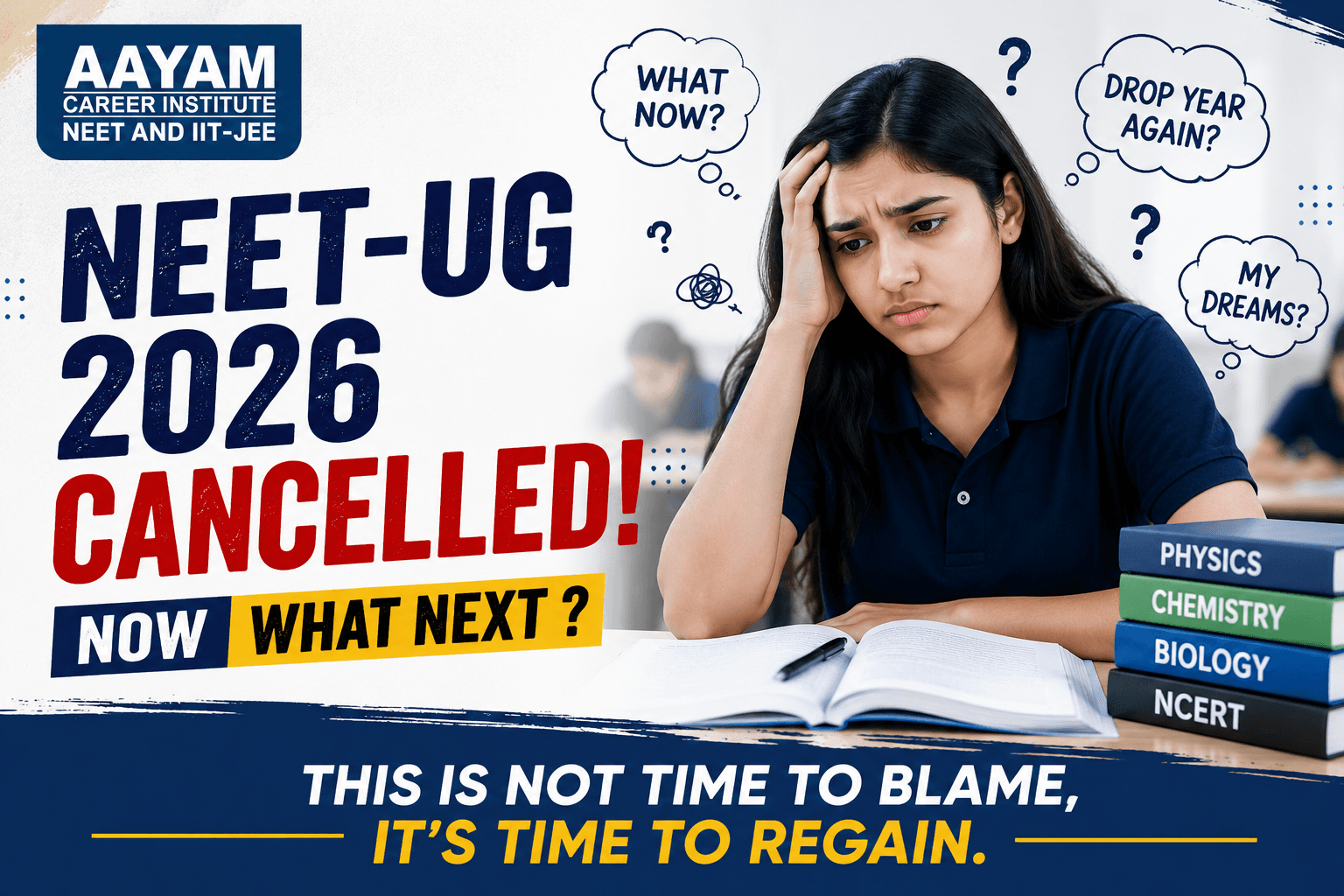
NEET UG 2026, conducted on 3 May 2026, has officially been cancelled by the National Testing Agency. This page explains what happened, why the re-exam may feel tougher, and how students should restart preparation without losing momentum.
The cancelled examination was conducted nationwide on this date.
NTA issued the official cancellation update on 12 May 2026.
Existing registration and candidature remain valid for the re-test.
Fresh exam dates and revised admit cards will be announced separately.
Overview
Students need clarity, not panic. This article is written to stabilise the situation and turn uncertainty into a preparation plan.
The National Eligibility cum Entrance Test, NEET UG 2026, has been cancelled after serious concerns were raised about the transparency and integrity of the examination process. The announcement has shocked lakhs of medical aspirants across India who sat for the exam on 3 May 2026.
At AAYAM Career Institute, we understand how emotionally exhausting this is for students and parents. Some students walked out of the exam hall feeling confident. Others were already thinking about results, counselling, and admissions. A sudden cancellation creates uncertainty, frustration, anger, and anxiety, but it does not end the journey.
This article arranges the complete situation clearly so students can stop reacting emotionally to rumours and restart with a stable, practical plan.
Official Context
The cancellation was announced after concerns were raised about the integrity and transparency of the exam process.
In its official statement, NTA said the decision was taken after inputs from central agencies and independent verification authorities raised concerns about the credibility of the examination process.
The Government of India has also referred the matter to the Central Bureau of Investigation for a comprehensive inquiry. Reports discussed in the attached draft indicate that investigators are examining allegations connected with paper leaks and organised malpractice networks.
For genuine students, this decision is emotionally painful. Even so, the authorities have made it clear that preserving trust in the national examination system was more important than allowing a compromised process to continue.
The exam conducted on 3 May 2026 stands cancelled.
A fresh examination will be conducted.
Students will not need to fill a new application form.
Existing registration and candidature remain valid.
New admit cards will be issued for the re-exam.
Fresh dates will be communicated through official channels.
Historical Parallel
The 2015 medical entrance re-exam is the clearest reference point for what students may experience now.
This is not the first time Indian medical entrance candidates have faced such a disruption. In 2015, the All India Pre-Medical Test, or AIPMT, which preceded NEET, was also cancelled after allegations of large-scale cheating and paper leaks surfaced.
Back then, the original AIPMT exam was conducted on 3 May 2015. Soon after the test, investigators uncovered the use of electronic devices, including Bluetooth-enabled systems and micro-SIM equipment, to transmit answers inside the exam ecosystem.
The matter reached the Supreme Court, which cancelled the entire examination on 15 June 2015 in order to protect the sanctity and credibility of the medical entrance system. A fresh exam was then conducted on 25 July 2015 under much tighter security conditions.
3 May 2015
After the exam
15 June 2015
25 July 2015
The biggest lesson from 2015 is simple: when a medical entrance exam is cancelled on fairness grounds, the re-exam is highly likely to happen and serious students must prepare for it early.
Difficulty Shift
The second paper may challenge students differently, both academically and mentally.
After controversies, exam bodies often try to reduce predictability and unfair advantage. That can lead to more concept-based questions, tougher options, higher analytical demand, and greater emphasis on application.
Once a paper has already been written, many broad expectations become familiar. To avoid repetition, the re-exam may be calibrated differently in structure, depth, or difficulty.
Even when the question paper itself is not dramatically harder, emotional fatigue can make it feel tougher. Stress, burnout, uncertainty, and self-doubt affect concentration and decision-making.
Students who were unhappy with their first attempt now get another opportunity and often prepare intensely. That changes rank vs marks dynamics and makes the field more competitive.
Recovery Plan
The goal right now is to recover structure quickly, not to wait for certainty.
The most dangerous mistake students make after an exam cancellation is taking a long emotional break and stopping preparation completely. Losing 10 to 15 days now can become costlier than any disappointment from the first attempt.
Students should treat the first exam as over and restart revision immediately. Whether the paper went well or badly no longer matters. From this point onward, the only useful question is how strongly you can prepare for the next attempt.
Do not keep replaying what score you might have got. The cancellation has reset the process for everyone.
Do not wait for re-exam dates, court discussions, social media predictions, or YouTube speculation before opening your books again.
Re-read Biology NCERT line by line, revise Physical Chemistry formulas, practise assertion-reason questions, and solve Physics numericals without rushing into entirely new resources.
You now know which sections consumed time, where silly mistakes happened, and which topics felt weaker than expected. Use that information wisely.

Mindset
Students are feeling different emotions right now, and both high scorers and disappointed candidates need a stable mindset.
A panic reaction often pushes students into 12 to 14 hour days that quickly create burnout. Consistency matters far more than emotional intensity.
Rumours, fake dates, fear-based videos, leaked-paper claims, and political arguments do not improve marks. Official notices and disciplined revision do.
Seeing the re-exam as a second opportunity can reduce stress and help students focus on correcting mistakes rather than mourning what is gone.
A stable body supports a stable mind. Good sleep, simple meals, hydration, and a fixed routine improve accuracy and recall.
Preparation Strategy
Students do not need a brand-new system. They need stronger revision, better diagnosis, and sharper execution.
Biology remains the highest-scoring section and should continue to be revised directly from NCERT.
Physics may become more conceptual in the re-exam, so formula memory alone will not be enough.
Chemistry can become the rank-deciding subject in a re-exam because it tests both speed and accuracy.
Timeline and Competition
The safest preparation assumption is that the re-exam may happen sooner than students expect.
As of 12 May 2026, the official re-exam date has not been announced. Students should be careful not to assume that the process will take months.
The AIPMT 2015 timeline shows that a reconducted medical entrance exam can happen within weeks once authorities finalise logistics and legal clarity. That means students should remain prepared for a much earlier date than social media discussions may suggest.
The safest approach is simple: prepare as if the exam can happen any time in the next few weeks.

Lessons and Support
The students who respond well now will carry the biggest advantage into the reconducted exam.
The biggest advantage went to students who resumed disciplined preparation immediately instead of waiting for certainty.
Stress and uncertainty broke the flow of many aspirants. Composed students protected their preparation better.
A stronger conceptual grip mattered more than passive reading when the re-test demanded better application.
Students who revised intelligently outperformed those who scattered attention across too many new books and resources.
At AAYAM Career Institute, our full faculty team stands with NEET aspirants during this difficult phase. This is not just an exam issue. It is an emotional challenge for students and parents who have invested years of discipline into a single dream.
Our aim is to help students stay focused, regain confidence, and prepare for the re-exam with a practical, high-yield plan instead of panic-driven effort.
Final Message
Students cannot control the cancellation, but they can absolutely control how they respond to it.
Dear students, one cancellation cannot define your future. Yes, this situation is unfair. Yes, it is emotionally exhausting. Yes, it hurts. But difficult phases do not cancel genuine preparation.
The students who remain disciplined now will emerge stronger. The next paper may become harder. Competition may increase. Pressure may rise. But your preparation can also become stronger.
This is not the time to quit. This is the time to rise again. Stay focused, stay calm, and stay consistent. Your MBBS dream is still alive.
The aim is not just one exam-day result. The aim is long-term success built through consistent preparation.
Quick Questions
These are the most immediate doubts students are asking after the cancellation update.
Yes. The examination conducted on 3 May 2026 was officially cancelled by NTA on 12 May 2026, with a re-conducted exam to be announced later.
No. The official update says that existing registration and candidature remain valid, so students do not need to submit a fresh form.
Yes, it can. The AIPMT 2015 example showed that a medical entrance re-exam can be organised within weeks once authorities finalise the process.
No. Students should restart revision immediately and prepare as if the re-exam can happen in the next few weeks.
It may be more concept-driven and mentally demanding, especially because authorities often try to reduce predictability after a controversy and students face higher emotional pressure in the second attempt.